



INTRODUCTION
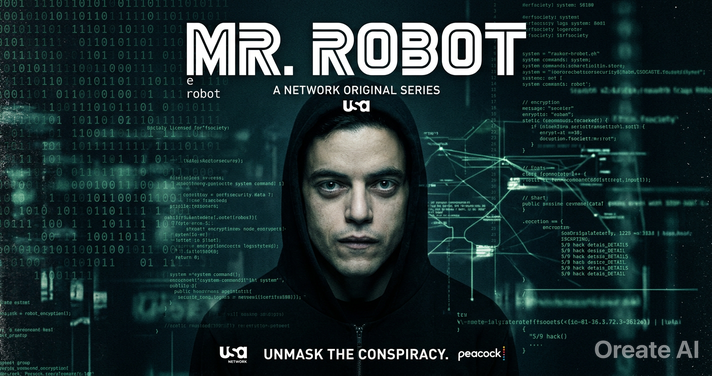
Once in a generation, a TV show comes along that doesn’t just entertain — it rewires your brain. Mr. Robot is that show. When it premiered on USA Network in June 2015, it landed like a system shock to the cultural mainframe: a technically precise hacking drama that doubled as a searing psychological portrait, a radical critique of late-stage capitalism, and a mind-bending meditation on identity and mental illness. Nothing on American television had ever felt quite like it.
At its center is Elliot Alderson, a cyber-security engineer by day and a vigilante hacker by night, whose fractured psyche makes him the most unreliable — and most compelling — narrator in recent TV history. When a mysterious anarchist figure known only as Mr. Robot recruits him to tear down the global financial system, Elliot becomes the unwilling architect of a revolution he can barely comprehend. The show’s famous opening line — “Hello, friend” — became a cultural touchstone, a whispered invitation into one of television’s darkest, most rewarding rabbit holes.
Mr. Robot arrived at the exact moment America needed it most: a post-Snowden, post-2008-crash world where the paranoia wasn’t paranoia at all — it was just paying attention. Creator Sam Esmail turned that anxiety into art.
GENERAL OVERVIEW
Created by Egyptian-American writer-director Sam Esmail and produced by Anonymous Content and Universal Cable Productions for USA Network, Mr. Robot ran for four seasons from 2015 to 2019, comprising 45 episodes. What began as a feature film concept evolved into one of the most ambitious serialized narratives in the prestige TV era. Esmail drew inspiration from his own outsider perspective as a first-generation American, the Arab Spring’s demonstration of digital organizing’s power, and a lifelong obsession with hacker culture and financial system fragility.
The show distinguished itself from the start through its extraordinary commitment to technical authenticity. Every hack shown on screen was verified by real cybersecurity professionals, a decision that earned Mr. Robot rare credibility in the tech community and set a new standard for how television depicts the digital world.
SYNOPSIS
Elliot Alderson works as a cyber-security engineer at Allsafe, a firm contracted to protect E Corp — a fictional conglomerate he privately calls “Evil Corp” — one of the world’s most powerful corporations. By night, he operates as a vigilante hacker, using his skills to expose and punish predators. Brilliant but severely mentally ill, Elliot struggles to separate reality from delusion, relying on the viewer as his only confidant.
Everything changes when Mr. Robot, the charismatic leader of an anarchist hacker collective called fsociety, recruits Elliot for the most ambitious cyberattack in history: wiping out all consumer debt by destroying E Corp’s financial records. As Elliot is pulled deeper into the conspiracy, the lines between revolution and manipulation, freedom and control, blur in ways neither he nor the audience could have anticipated.
CAST AND CREATORS
Rami Malek delivers what many critics consider the defining TV performance of the 2010s as Elliot Alderson. His portrayal — physically hunched, verbally spare, emotionally electric — earned him the Primetime Emmy Award for Outstanding Lead Actor in a Drama Series in 2016, a historic win that announced him as one of his generation’s great screen actors. Christian Slater brings unexpected depth and menace to the enigmatic Mr. Robot, a role that won him the Golden Globe for Best Supporting Actor.
Carly Chaikin is a revelation as Darlene Alderson, fsociety’s fiercest true believer, while Portia Doubleday traces a devastating arc as Angela Moss, Elliot’s childhood friend whose idealism collides with brutal reality. Martin Wallström’s Tyrell Wellick — ambitious E Corp VP with ice in his veins — becomes one of television’s most fascinatingly complex antagonists. B.D. Wong’s Whiterose rounds out an ensemble of remarkable depth. Behind the camera, Esmail made the extraordinary decision to direct every episode of Season 2 himself, an almost unprecedented move for a showrunner that cemented his auteur credentials.
PRODUCTION AND DISTRIBUTION
Mr. Robot is produced by Anonymous Content and Universal Cable Productions, with its original US broadcast on USA Network beginning June 24, 2015. Shot primarily on location in New York City — its dense urban geometry perfectly mirroring the show’s claustrophobic paranoia — the series ran for four seasons totaling 45 episodes, with episodes averaging 54 minutes. The fourth and final season comprised 13 episodes, the series’ longest. The show is currently available for streaming on Peacock in the United States.
STYLE, TONE AND THEMES
Visually, Mr. Robot is unlike anything else in American television. Esmail and cinematographer Tod Campbell developed a signature grammar of disorienting framings: characters pushed to the edges of the screen, vast empty spaces dominating the center, compositions that feel perpetually off-balance. It’s the visual language of dissociation — the world rendered from the perspective of a man who has never felt he belongs in it.
The show’s thematic ambitions are equally striking. At its core, Mr. Robot is about power: who holds it, how it’s maintained, and what happens to those who try to dismantle it. Its targets — corporate monopolies, financial surveillance, the illusion of democratic accountability — remain as relevant today as when the show first aired. Mac Quayle’s pulsing, electronic score keeps the tension coiled throughout, while the show’s deployment of pop culture references (everything from Seinfeld to Back to the Future) creates a dissonant portrait of American consciousness.
WHAT MAKES IT GREAT
The technical authenticity of its hacking sequences remains unmatched in television — this is what actual network intrusion, social engineering, and digital forensics look like, not Hollywood fantasy. Rami Malek’s performance is a career-defining achievement for an actor who went on to win an Academy Award. The show’s narrative construction over four seasons is a masterwork of long-form storytelling: patience rewarded, clues planted episodes — sometimes seasons — in advance, a finale that pays off every bet the show ever made. And Esmail’s visual sensibility gives every season the feel of a prestige film, not a weekly television serial.
WHO SHOULD WATCH
If you were riveted by Fight Club’s deconstruction of masculine identity and consumerism, if you lost sleep over the implications of the Snowden revelations, if you believe that the most interesting protagonist in fiction is an unreliable one — Mr. Robot was made for you. Tech professionals will appreciate the rare accuracy; thriller fans will be gripped by the propulsive plotting; and anyone who’s ever felt alienated by a world that seems to be running on systems designed to keep most people out will recognize something of themselves in Elliot Alderson.
CRITICAL RECEPTION AND CULTURAL IMPACT
The numbers tell part of the story. Season 1 holds a 98% rating on Rotten Tomatoes. The series received 12 Primetime Emmy nominations and won three, including Outstanding Lead Actor in a Drama Series for Malek. At the 73rd Golden Globe Awards in 2016, Mr. Robot won Best Television Series — Drama, beating Game of Thrones in an upset that shocked the industry and confirmed the show as prestige television’s newest standard-bearer. Christian Slater took Best Supporting Actor in a Series that same night. The show also earned a Peabody Award, a Writers Guild of America Award, and critical year-end honors from Entertainment Weekly, Rolling Stone, and TV Guide. Beyond awards, Mr. Robot permanently changed how Hollywood depicts hacking and digital culture — a legacy that will outlast its four seasons.
SIMILAR WORKS
Fight Club (David Fincher, 1999) — The spiritual predecessor. Same fractured psyche, same anti-capitalist rage, same twist-dependent narrative architecture. Essential viewing before or after Mr. Robot.
Black Mirror (Charlie Brooker, Netflix, 2011-) — The UK’s most unsettling anthology on technology’s dark consequences. Where Mr. Robot is serialized, Black Mirror is episodic — but the shared DNA of digital paranoia is unmistakable.
Halt and Catch Fire (AMC, 2014-2017) — A love letter to the pioneers of the personal computer age, sharing Mr. Robot’s reverence for and skepticism toward American tech culture.
Mindhunter (David Fincher, Netflix, 2017-2019) — For the same meticulous visual craft, psychological depth, and willingness to let intelligence drive narrative over adrenaline.
Succession (HBO, 2018-2023) — If Mr. Robot is interested in tearing down corporate power from outside the system, Succession burns it from within. Together, they form the definitive TV portrait of American capitalism’s rot.
CONCLUSION
There’s a reason cybersecurity professionals screen Mr. Robot in university courses. There’s a reason it’s discussed in the same breath as The Wire and Breaking Bad when serious critics talk about television’s artistic ceiling. Sam Esmail built something that transcends genre: a four-season argument about power, identity, and the fragile fictions that hold society together. In an era when the anxieties it dramatizes have only deepened, Mr. Robot doesn’t just hold up — it feels more urgent than ever. If you haven’t watched it, the time is now. And if you have: it’s even better the second time. Hello, friend.