


A Crossroads of Civilizations, a Symphony of Cultures
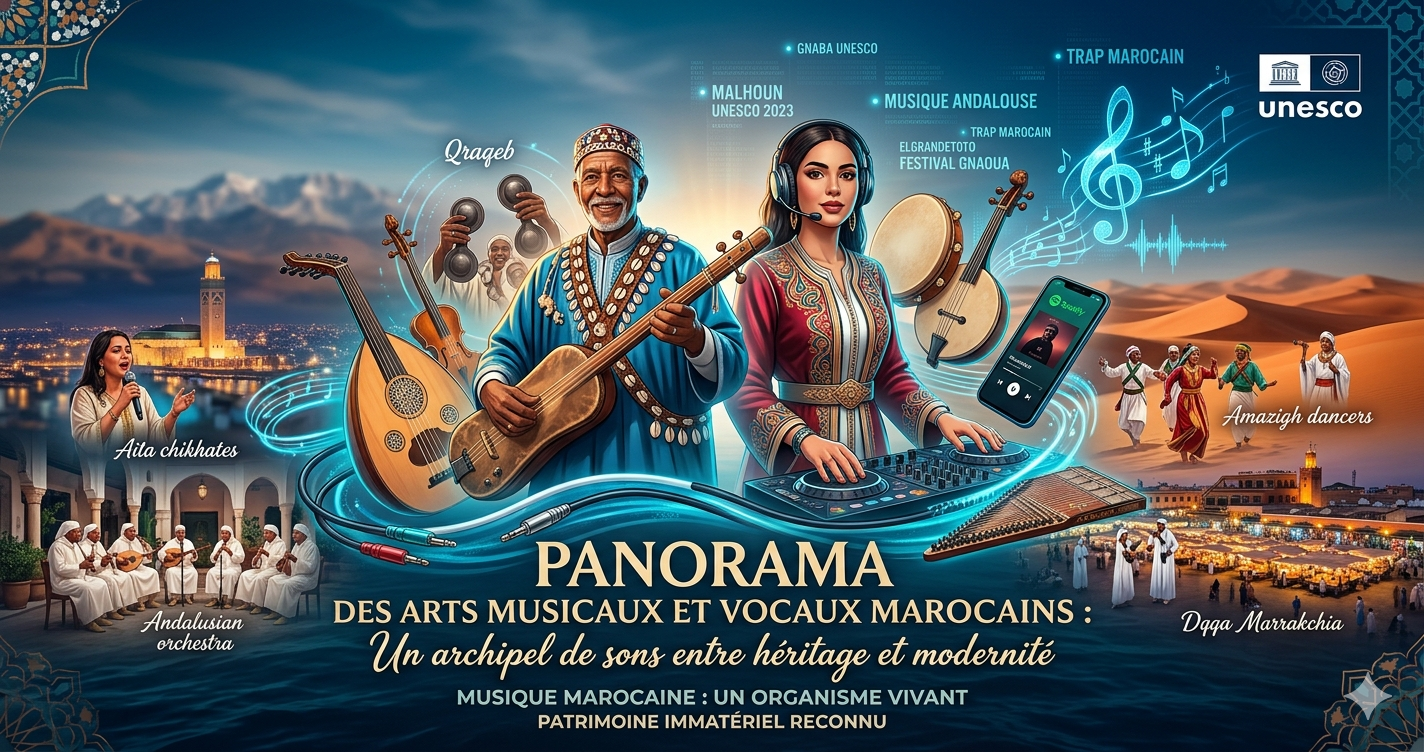
It is seven o’clock on a Marrakech evening. On the famous Jemaa el-Fna square — listed by UNESCO in 2008 as a “cultural space of humanity” — a Gnawa maalem plucks the first deep notes of his guembri. The iron qraqeb respond with a metallic shimmer. A circle forms. Fifty meters away, an elderly man recites a Malhoun poem to the wavering sound of a rebab. Neither performance was announced; neither requires a stage. They have simply always been here.
This scene encapsulates something essential about Moroccan music: it is not a monument to be preserved behind glass, but a living organism. From the Atlas mountains, where Amazigh ahidous resonates across stone villages, to the Sahara, where Hassani nomadic chant carries centuries of oral poetry, to the medinas of Fes and Rabat, where Andalusian orchestras play suites composed eight hundred years ago — Morocco is a sonic archipelago of extraordinary depth.
Understanding this richness means tracing the history of a country where Amazigh, Arab-Andalusian, West African, and Saharan heritages have intertwined for millennia without ever fully merging into one.
1. The Classical Tradition: Heritage of Al-Andalus
When Granada fell to the forces of the Reconquista in 1492, thousands of Muslim and Jewish musicians, poets, and scholars fled to Morocco, settling in Fes, Tetuan, Rabat, and Oujda. They brought with them a musical treasure refined over centuries: the nouba, a vocal and instrumental suite of breathtaking sophistication.
In Morocco, this tradition takes two principal forms. Tarab al-Ala (“the noble music”), dominant in Fes, Meknes, and Tetuan, is the classical form par excellence. Orchestras gather the oud (lute), qanun (zither), violin, and percussion instruments, with singers dressed in white djellabas and red fez hats. Each nouba follows a strict rhythmic progression — from the slow msaddar to the lively quddams — and may last for hours.
The Gharnati style (“music of Granada”), more common in Rabat, Sale, and Oujda, draws from the same source but with a more lyrical, poetic flavor. It alternates between instrumental improvisation, choral refrains, and songs celebrating love, friendship, and nature — a dialogue between the sacred and the profane.
Closely related is the Malhoun, inscribed on UNESCO’s Intangible Cultural Heritage list in 2023. Emerging from the artisanal guilds of Fes and Meknes in the 12th century, it sets dialectal Arabic poetry to music drawn from Andalusian modes. More accessible than the Ala, the Malhoun was long the music of craftsmen and tradespeople, carrying social commentary and love narratives in equal measure.
| Genre | Main Cities | Key Feature | UNESCO Status |
| Al-Ala (Andalusian) | Fes, Tetuan, Meknes | Nouba suites, classical orchestra, oud & qanun | National classified heritage |
| Gharnati | Rabat, Sale, Oujda | Grenadan heritage, improvisation & chorus | Maghrebi shared heritage |
| Malhoun | Fes, Meknes, Marrakech | Dialectal Arabic poetry & music, rebab lute | UNESCO inscribed 2023 |
2. Chaabi and Aita: The Voice of the People
Chaabi — literally “popular” in Arabic — encompasses an enormous musical universe: the soundtrack of Moroccan weddings, cafes, street radios, and diaspora playlists. Rooted in Andalusian modes but sung in Darija (Moroccan Arabic), Moroccan chaabi differs markedly from its Algerian counterpart. It centers on a lead vocalist accompanied by a small ensemble — guinbri, bendir (frame drum), and sometimes a ghaita (ceremonial oboe) — and draws its themes from everyday life, love, and social commentary.
The towering figure of Abdelhadi Belkhayat, widely considered the patriarch of classical chaabi, continues to influence generations of singers long after his recordings first circulated. His approach — emotional directness wrapped in musical refinement — remains the benchmark.
The Aita belongs to the Atlantic plains stretching between Casablanca and Marrakech. Performed by female vocalists known as chikhates, it weaves together love laments, epic narratives, and socially charged lyrics. Its long, undulating vocal lines over percussion patterns make it instantly recognizable. In recent years, the Aita has attracted growing scholarly and artistic attention, particularly within the Moroccan diaspora in France and the Netherlands.
3. Amazigh Music: Memory of the Mountain
Morocco is as Amazigh as it is Arab. The Berber peoples — the country’s oldest inhabitants — have developed musical traditions across millennia that differ dramatically from one region to another, reflecting the diversity of the Atlas, Rif, Souss, and Saharan landscapes.
The Ahidous of the Middle Atlas is a collective dance-song in which men and women stand side by side in a circular formation, shoulder to shoulder. Accompanied by the bendir and alternating voices that echo each other across the circle, it transforms a village gathering into a living sound entity. It expresses joy, mourning, seasonal celebrations, and collective memory.
The Ahwach, widespread in the Souss Valley and High Atlas, has a more theatrical structure: musicians arrange themselves in opposing rows, trading chants in complex call-and-response patterns, with bendir and ta’rija percussion marking intricate choreographic transitions. Both traditions are transmitted orally and remain fully alive, presented regularly at moussems (pilgrim festivals) and regional celebrations.
The Reggada of the eastern Rif, a warrior-derived dance marked by mock rifle gestures, and the Aarfa of the north round out this panorama. They share a common philosophy: music here is not a performance but a communal act.
- Notable: The 2021 Anthology of the Rrways — Amazigh itinerant poet-singers — received the Prix : Coups de Coeur Musiques du Monde from the Academie Charles Cros, highlighting the international, reach of Morocco’s Amazigh vocal traditions.
4. Spiritual Music: Between Trance, Healing, and Transcendence
Deep in the Marrakech medina on a moonlit night, a ceremony is beginning. Incense fills a courtyard. Color-coded costumes are donned. A maalem settles cross-legged and plucks the first notes of his guembri. The lila has begun.
Gnawa music is far more than a genre. It is an integrated healing system, born from the forced migration of West Africans to Morocco between the 16th and 19th centuries. From their homelands — present-day Mali, Ghana, Guinea, and Nigeria — they carried musical practices linked to the invocation of spirits (mluk), which over time merged with Moroccan Sufi Islam to produce something entirely unique.
The guembri (or sintir), a three-stringed bass lute with a camel-skin resonator, produces a low, hypnotic drone. The qraqeb, heavy forged-iron castanets, impose a metallic, relentless pulse. Together, they construct what ethnomusicologists describe as the infrastructure of trance. The lila ceremony progresses through color-coded suites, each associated with a different spirit or energy, guiding participants toward jedba — a state of altered consciousness seen as therapeutic and sacred.
In 2019, UNESCO inscribed Gnawa on its Representative List of the Intangible Cultural Heritage of Humanity, defining it as “a set of musical events, performances, fraternal practices, and therapeutic rituals mixing the secular with the sacred.” This recognition strengthened community pride and global visibility, while also provoking internal debate about how to navigate the tension between preservation and spectacularization.
Morocco’s other spiritual brotherhoods add further layers. The Aissawa of Meknes and the Hamadcha of the Middle Atlas present their own trance rituals, which draw on Sufi mysticism and communal healing. The Dqqa Marrakchia — a collective percussion and chanting tradition — is among the most visually striking ceremonies in the country.
5. Sahara Music: Songs of the Desert
South of the Draa River, sound changes its texture. Hassani music, sung by the Sahrawi and nomadic Reguibat peoples, carries a poetics of vastness — open desert, wheeling stars, and the solitude of long travel. Hassani oral poetry follows a complex prosodic system in which improvisation and memory are equally prized; to master it is to carry centuries of tribal history in one’s throat.
The Guedra, a trance dance performed by women in the Tan-Tan and Laayoune regions, is among the most arresting expressions of southern Morocco. The dancer kneels and allows her hands to speak a slow, symbolic language of gestures. When trance is reached, the body yields, marking a moment of contact with the invisible. The Moussem of Tan-Tan, UNESCO-listed since 2008, is the great annual gathering where these traditions take center stage, drawing nomadic communities from across the Western Sahara.
6. The Contemporary Scene: From Gnawa Fusions to Moroccan Trap
The 1970s marked the beginning of a Moroccan musical revolution. Nass El Ghiwane — widely called “the Rolling Stones of Morocco” — merged chaabi, Gnawa, African percussion, and politically charged poetry to create a sound that voiced the frustrations and aspirations of a post-colonial generation. Jil Jilala and Lemchaheb followed, making Casablanca a simmering musical laboratory.
Today, the urban scene burns with a new energy. Moroccan rap — fusing Darija, French, and English over trap and RnB beats — has established itself as the language of youth. ElGrandeToto has been Morocco’s most-streamed artist on Spotify for six consecutive years (2020-2025), blending melodic trap and poetic Darija. Faouzia, born in Morocco and raised in Canada, collaborates with David Guetta and headlined a world tour. Manal generated 30 million YouTube views with her single ‘Nah,’ while Mounim Slimani fuses chaabi rhythms with international pop.
Crucially, these artists are not turning their backs on tradition — they are reinterpreting it. At the Gnaoua and World Music Festival in Essaouira (26th edition, June 19-21 2025, 350 artists, 54 concerts), maalems have for years collaborated with jazz, blues, and electronic producers from around the world, creating fusions that carry both the spiritual depth of the lila and the pulse of the contemporary. The Berklee College of Music partnership at the 2025 Festival brought students from 23 countries to study alongside Gnawa masters.
KEY FIGURE: ElGrandeToto — Morocco’s top Spotify artist 6 consecutive years (2020-2025).
FESTIVAL: Gnaoua Festival 2025 — 350 artists, 40 Gnawa masters, 54 concerts over 3 nights.
MILESTONE: Gnawa music inscribed UNESCO Intangible Cultural Heritage (2019).
7. Transmission and Preservation: Keeping the Living Alive
Morocco’s musical heritage does not live in archives — it lives in transmission, through imitation, repetition, and proximity. Gnawa maalems have traditionally initiated their apprentices from childhood, passing on the entire system of spiritual music and ritual knowledge within brotherhood communities (zaouias). Andalusian orchestras perpetuate a centuries-old master-student relationship, codified since the medieval period.
The Moroccan state has increasingly formalized this transmission. The “Treasures of Moroccan Traditional Arts” program, run by the State Secretariat for Artisanal Arts in partnership with UNESCO, recognizes exceptional traditional masters across music, craft, and performance. Its 2025 (third) edition named 15 new living treasures overseeing 150 apprentices. The country’s music conservatories — in Fes, Meknes, Rabat, and Casablanca — train hundreds of students yearly in Andalusian, Amazigh, and popular music traditions.
Festivals play an irreplaceable role in this transmission chain: the Gnaoua Festival in Essaouira, the Festival of Sacred Music in Fes, the Tanger Jazz Festival, and Mawazine in Rabat are all stages where tradition meets innovation in front of live audiences numbering in the hundreds of thousands.
Conclusion: A Sonic Archipelago in Perpetual Motion
Moroccan music is an archipelago: distinct islands, each with its own history, instruments, rituals, and aesthetics, connected by underwater currents that make them resemble one another without ever becoming the same. Between the nouba of Fes and the trap of Casablanca, between the Gnawa lila of Essaouira and the Guedra of Tan-Tan, centuries of history and vast geographies separate these sounds — and yet a shared quality binds them: the belief that music matters most when it reaches toward something essential, whether that is the divine, the community, or the self.
With 16 elements on UNESCO’s Intangible Cultural Heritage list, a digital scene generating hundreds of millions of streams, and successive generations of artists who refuse to choose between heritage and modernity, Morocco stands as one of the most compelling musical laboratories in the Arab world and the African continent.
The Royal Opera of Morocco