




Morocco Air Traffic 2026: Airports Handle Over 22 Million Passengers
Morocco’s aviation sector continues to expand in 2026. According to the latest statistics from the National Airports Office (ONDA), Moroccan airports handled 22,282,997 passengers between January and July 2026, representing an increase of 8.77% compared with the same period in 2025.
July alone accounted for 3,450,846 passengers, highlighting the impact of the summer travel season. The figures underline the growing importance of air transport for Morocco’s tourism industry, international connectivity and economic activity.
International traffic remains dominant
International routes accounted for 19,894,489 passengers during the first seven months of 2026, an increase of 8.82% year on year.
Domestic traffic also recorded positive growth, reaching 2,388,508 passengers, up 8.36%.
Europe remains Morocco’s largest aviation market. European routes handled 16,541,007 passengers during the period, an increase of 9.29%.
Other markets also recorded significant growth. South American traffic increased by 34.21%, while North American traffic rose by 14.54%. African routes grew by 13.74%.
Casablanca and Marrakech lead the network
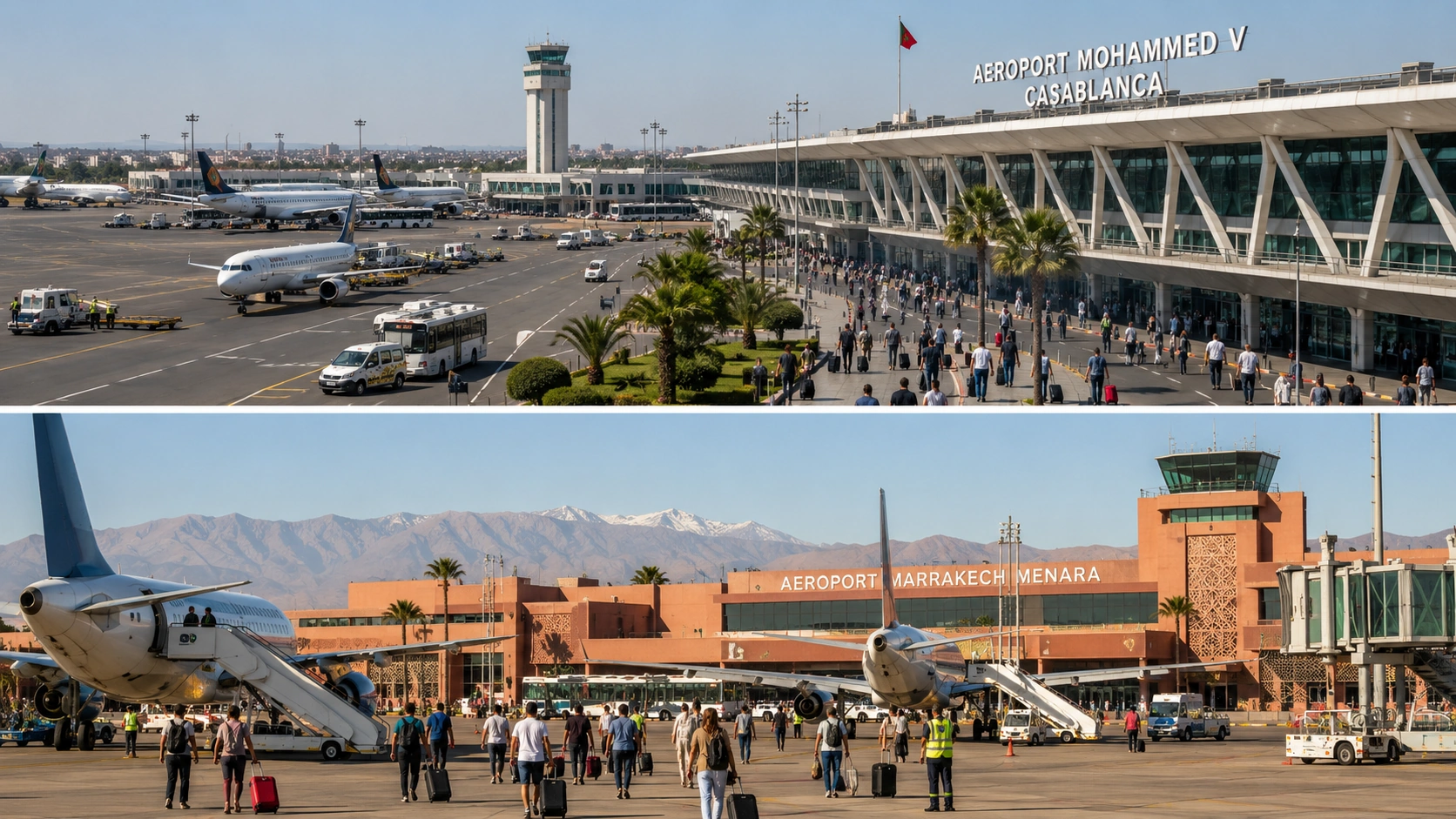
Casablanca Mohammed V Airport remains Morocco’s busiest airport. It handled 6,953,695 passengers between January and July 2026.
Marrakech-Ménara Airport followed closely with 6,407,303 passengers. Its strong performance reflects the importance of Marrakech as one of Morocco’s leading international tourism destinations.
Agadir-Al Massira ranked third with 2,179,857 passengers, followed by Tangier Ibn Battouta with 1,711,764 and Rabat-Salé with 1,446,355.
July puts airport capacity under pressure
The 3.45 million passengers recorded in July illustrate the pressure created by the summer peak. Tourism, holiday travel and movements by Moroccans living abroad generate particularly strong passenger flows during this period.
At the same time, Airports of Morocco has been implementing measures aimed at improving passenger processing. Reported improvements in border-control processing times are part of a wider effort to make the airport experience faster and more efficient.
Nearly 165,000 aircraft movements
Passenger growth has been accompanied by an increase in aircraft activity. Moroccan airports recorded 164,164 aircraft movements during the first seven months of 2026, up 9.82% compared with the previous year.
Casablanca Mohammed V recorded 55,223 movements, while Marrakech-Ménara registered 42,028 and Agadir-Al Massira 15,009.
Air cargo also continued to grow. Moroccan airports handled approximately 66,980.55 tonnes of freight during the period, representing a 12.61% increase.
Airports 2030 aims to match future demand
The continued increase in passenger numbers is putting additional pressure on airport infrastructure. Morocco’s “Airports 2030” strategy aims to expand capacity, modernize facilities and improve the passenger experience.
The largest project is planned at Casablanca Mohammed V Airport. The future terminal is expected to cover approximately 600,000 square meters and provide an initial annual capacity of 20 million passengers, expandable to 30 million.
The project is also expected to connect with the future Tangier-Marrakech high-speed railway line. Completion is planned around 2029.
Marrakech and Agadir are also expanding
Marrakech-Ménara is expected to eventually reach an annual capacity of 11.5 million passengers. The expansion is intended to support the continued growth of international tourism.
At Agadir-Al Massira, development projects are designed to increase annual capacity to approximately 4.4 million passengers.
Aviation becomes increasingly strategic for Morocco
The first seven months of 2026 confirm the strategic importance of aviation to Morocco’s economy. More than 22 million passengers, almost 165,000 aircraft movements and nearly 67,000 tonnes of cargo demonstrate the scale of activity handled by the national airport network.
The next challenge will be to maintain this growth while preserving passenger service quality. Terminal modernization, digitalization, automated border processing, baggage handling and improved rail connections will all play an increasingly important role.
For Morocco, airport development is therefore about more than aviation. Airport capacity directly affects tourism, international trade, investment and the country’s ability to strengthen its connections with Africa, Europe, Asia and the Americas.
Sources: National Airports Office (ONDA), 2026 commercial air traffic statistics; Airports of Morocco; public information reported by MAP and Moroccan media. Data through July 2026.



1 comment
Great information shared.. really enjoyed reading this post thank you author for sharing this post .. appreciated